I Hated My House After the Renovation: A Story of Loss, Isolation, and the Grief Nobody Talks About
My husband renovated our home and did a beautiful job — and I hated it. This is the story of the grief nobody warns you about: how progress can quietly sever connection, and what near-death experiences and the year 1987 taught me about finding our way back.
I need to tell you something that makes me sound ungrateful.
My husband renovated our home. He did a beautiful job. The new kitchen is modern, functional, everything a kitchen should be. People walk in and say, “Oh, this is lovely.”
And I hate it.
I have hated it from the moment I understood what I’d lost. Not because anything went wrong with the renovation. Because everything went wrong with me — or at least, that’s what I told myself for a long time. Because how do you explain to someone that they just destroyed the heart of your home while building you a better one?
The Heart of the Home
Let me tell you what we had before.
Our old kitchen wasn’t really a kitchen. It was part of the lounge and dining area — open, flowing, alive. When I cooked, I wasn’t sealed off in some separate room performing a task. I was in the evening. I could hear the conversation shifting from the couch. I could catch my husband’s eye across the room. I could feel the weight of a pause in the conversation, notice when someone went quiet, laugh at the thing that was only funny because of timing.
I wasn’t just making dinner. I was participating in life.
The kitchen bench faced the room. People sat on the other side — wine glass in hand, elbows on the counter, talking about nothing and everything. Kids drifted through. The dog settled at my feet. The television murmured in the background. And I was there, in the middle of all of it, connected to every thread.
That was the heart of the home. Not the stove, not the countertop, not the layout on a floor plan. The connection. The fact that cooking wasn’t isolation — it was communion.
And then there was my room.
The Sanctuary
I had a room. God, I had a room.
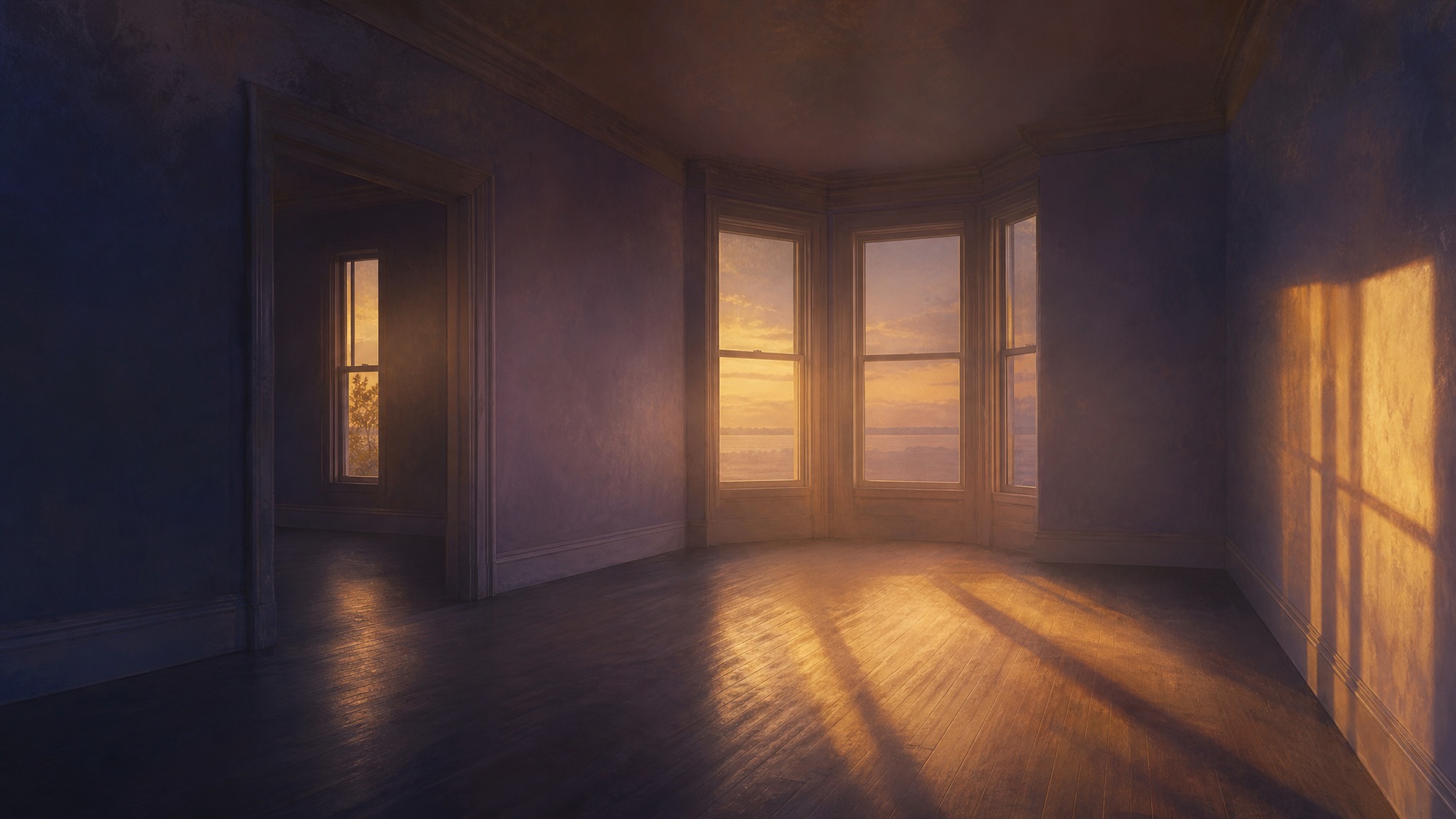
Four metres by six or seven — generous, open, breathing. Floor-to-ceiling windows that let in everything. Morning light that pooled across the floor. Afternoon sun that turned the walls gold. I could sit in that room for hours and feel held by the space itself.
That was where I worked. Where I thought. Where I wrote, read, stared out the window and let ideas arrive in their own time. It wasn’t just a room — it was a sanctuary. The place where I could be most fully myself, undisturbed, surrounded by light and silence and the particular quality of attention that only comes when a space fits you like a glove you didn’t know you’d been wearing.
I loved that room the way you love something you don’t realize you depend on until it’s gone.
What the Renovation Took
The renovation moved the kitchen into my room.
My sanctuary — that beautiful, light-filled space where I sat and worked and breathed — became the new kitchen. And the kitchen that had been the heart of the home, the one that opened into the living area, the one where I could see and hear and be part of everything — that was gone too, absorbed into the new open-plan layout in a way that sounds like an improvement on paper but felt, in practice, like an amputation.
The new kitchen is beautiful. I need to say that clearly, because it’s true. It’s well-designed, well-built, objectively better in every measurable way.
But there’s no room to sit on the other side of the bench anymore. There’s just a tiny table by the window. When I cook now, I cook alone. The conversation happens somewhere behind me, in another room, muffled, distant. I can’t see faces. I can’t catch the shift in someone’s expression. I can’t feel the rhythm of the evening.
I stand in my beautiful new kitchen and I am cut off.
The isolation crept in like weather. Not dramatic, not sudden. Just a slow, cold settling. The house got better and I got lonelier. The walls were new and the light was different and everything worked perfectly and I felt like a stranger in my own home.
I hated it. I hated it and I couldn’t say so, because hating it made me sound insane.
The Grief Nobody Warns You About
Here’s what I’ve learned since: I was grieving.
Not metaphorically. Not being dramatic. Genuinely, bodily, neurologically grieving — the loss of connection, the loss of my sanctuary, the loss of the invisible architecture that had held my daily life together in ways I never thought to name until it was demolished.
Elisabeth Kübler-Ross identified five stages of grief — Denial, Anger, Bargaining, Depression, Acceptance — and she was always careful to say they don’t arrive in order. They overlap. They circle. They ambush you at strange moments. She developed them by sitting with dying patients, but the structure applies to any real loss.
I went through every single one. Not neatly. Not gracefully.
Denial came first and lasted longest. I’m not sad about a kitchen. That’s ridiculous. It’s just a room. Get over yourself.
Anger arrived hot and irrational. I was furious — at the renovation, at the choices, at the fact that nobody seemed to understand what had been lost. The anger had nowhere to go because the renovation was good. It was an improvement. Being angry about an improvement felt like madness.
Bargaining was subtle. Maybe if I rearranged the furniture. Maybe if I found a new spot to work. Maybe if I put a chair here, a lamp there, I could reconstruct something that felt like what I’d had. I couldn’t. You can’t reconstruct connection with furniture placement.
Depression was the hardest stage because it didn’t announce itself. It just was. A low-grade heaviness that lived in my chest. A reluctance to be in the kitchen. A sense that something essential was missing but trying to explain it would make me sound ungrateful, unhinged, or both. I withdrew. The isolation the kitchen imposed became the isolation I carried everywhere.
Acceptance — I’m still working on acceptance. I’ll be honest about that. Some days the new kitchen is just a kitchen and I’m fine. Other days I stand at the bench and feel the ghost of what used to be and the grief comes back, quieter now but still there.
What made it so disorienting was the social impossibility of it. You chose this. Your husband did this for you. The house is better. Be grateful. And so the grief had nowhere to go. I swallowed it. I smiled when people admired the renovation. I said nothing about the room I’d lost, the connection I’d lost, the self I couldn’t find in this new, improved space.
But here’s what I’ve come to understand: the thing I was grieving wasn’t a kitchen or a room. It was connection. The old kitchen connected me to the people I loved. My old room connected me to myself. The renovation, for all its beauty, severed both.
And that — that pattern of progress destroying the very thing that mattered — turns out to be much bigger than my house.
What the Dead Know About Connection
Since the late 1970s, researchers have been documenting something extraordinary: the Near-Death Experience. People whose hearts stop — on operating tables, in accidents, in the water — are brought back. And a remarkable number of them report the same core experience: leaving the body, passing through darkness, encountering overwhelming light, reviewing their lives, reaching a boundary they cannot cross.
What fascinates me isn’t what they see. It’s who they become.
Researchers like Kenneth Ring, Pim van Lommel, and Bruce Greyson have found that people who return from clinical death are changed — consistently, measurably, and in the same direction. They lose interest in material accumulation. They become more sensitive to the emotions of others. They lose their fear of death. And overwhelmingly, they report the same thing: an unshakeable sense of interconnection. The felt understanding that separation is an illusion. That consciousness isn’t locked inside one skull, one body, one kitchen.
They die, they come back, and the walls come down.
I read about NDEs during the worst of my kitchen grief — I can’t even remember how I found the research, probably late at night, probably looking for something that would make my feelings make sense — and I felt something click.
Because the structure is identical.
In an NDE, the container of identity dissolves. The ego — the familiar “self” you’ve been living inside — is demolished. And what’s left isn’t emptiness. It’s more. More connection, more feeling, more awareness of the web that holds everything together.
The NDE is a renovation of the self. The old structure gets torn down. There’s a period of profound disorientation. And if the person lets it happen — if they don’t clamp down and try to rebuild the old walls — they emerge into a fundamentally different relationship with life. One built on connection rather than separation.
My kitchen renovation demolished my connection and left me with beautiful isolation.
An NDE demolishes isolation and leaves you with overwhelming connection.
Same process. Opposite direction. And the difference is what gets preserved through the transition: walls or openings.
1987: The Year We Lost the Heart of the Home
Here’s where it gets bigger than me and my kitchen.
There’s a case to be made that in 1987, humanity collectively went through something structurally identical to what I experienced — and to what NDErs describe. Not individually. As a species.
Consider what happened in a single twelve-month window:
The ozone crisis peaked. Scientists confirmed that the protective layer shielding all life on Earth was being destroyed — by us. Our own products, our own progress, our own “improvements” were eating a hole in the sky. For the first time, we faced the scientifically verified reality that we were making our own planet uninhabitable. We were standing in our beautiful renovated house realising the heart had been ripped out.
The nuclear winter hypothesis had entered mainstream consciousness. Carl Sagan and colleagues had demonstrated that even a limited nuclear exchange could end agriculture and most complex life. We had built weapons so powerful they could render our home unlivable. Progress. Improvement. Annihilation.
The Montreal Protocol was signed — an extraordinary act of global cooperation in which nations agreed to stop producing the chemicals killing the ozone layer. Humanity looked at its own death and chose to change. This remains one of the most successful international agreements ever achieved. We grieved, and we acted.
The Harmonic Convergence took place in August — the first globally synchronized meditation event, drawing tens of thousands to sacred sites worldwide. Whatever you make of the New Age framing, the impulse was real: a felt sense that something fundamental was shifting, that the species was at a threshold.
And in October 1987, the Dalai Lama and a group of scientists sat down together in Dharamsala for the first Mind and Life dialogue — a conversation between contemplative wisdom and Western neuroscience that would eventually help reshape how science thinks about consciousness, connection, and the mind.
I look at this list and I see my kitchen.
I see a species that had been living in an open-plan arrangement with the natural world — connected, participatory, embedded in the rhythms of the planet the way I was embedded in the rhythms of my old kitchen. And then, gradually and then all at once, we renovated. We moved into the new structure of industrialisation, extraction, consumption. The new arrangement was powerful, efficient, measurably superior in every way.
And it was isolating.
We couldn’t hear the rivers anymore. We couldn’t feel the forests. We couldn’t catch the eye of the natural world across the room and sense that we were part of the same evening. We stood in our gleaming modern civilisation and we were cut off — from each other, from the earth, from the web of life that had held us for two hundred thousand years.
1987 was the year the species looked up from the beautiful new countertop and felt the grief.
Progress and Its Amputations
I keep coming back to this: progress isn’t the problem. Disconnection is.
My new kitchen isn’t bad. It’s the isolation it created that devastated me. Industrial civilisation isn’t evil. It’s the severance from connection — to nature, to each other, to the felt sense of being part of something larger — that’s killing us.
Individual NDErs come back from death and discover that the life they built no longer fits. The career feels hollow. The possessions feel absurd. The relationships built on pretence become intolerable. They haven’t lost their minds. They’ve lost their previous operating system — the one that ran on separation, on walls, on the illusion that you could seal yourself off in a better room and still be whole.
The new operating system runs on connection. And it takes time to install.
Humanity is mid-installation. The old system — the one that treated the earth as a resource depot, that measured progress by consumption, that renovated the planet without asking what was being lost — is crashing. The new one, the one that 1987 pointed toward, the one built on the understanding that we are not separate from each other or the living world, is struggling to boot up.
And the lag between the old system shutting down and the new one coming online? That’s where we live right now. That’s the kitchen that doesn’t feel like home yet. That’s the species standing in its gleaming new civilisation, surrounded by every comfort, wondering why it feels so alone.
Sitting in the Grief
I still miss my room. I miss the light through those floor-to-ceiling windows. I miss the feeling of sitting in a space that was mine — not the kitchen, not shared, not functional, just a place where I could think and be.
I still miss the old kitchen. Not the fixtures, not the layout on a blueprint. The feeling of it. The way cooking was connection. The way I could stand at the bench and be part of the living room, part of the conversation, part of the evening’s unfolding.
I don’t think I’ll ever fully stop missing those things. And I’ve stopped trying to. Because I’ve come to believe that the grief itself is meaningful — not just as something to get through, but as information. A signal. A recognition that connection mattered, that what was lost was real, and that noticing the loss is not weakness but a kind of fidelity to what matters most.
The NDErs don’t come back and forget what they experienced. They come back and reorganise their lives around it. The connection they felt at the threshold becomes the thing they orient toward. The walls they’d built — career walls, status walls, the walls of the separate self — start coming down. Not because they’re reckless, but because they’ve seen what’s on the other side.
I think that’s what grief is asking of us. Personally, and as a species. Not to pretend the loss didn’t happen. Not to paste gratitude over genuine pain. But to let the loss teach us what we actually need.
I needed connection. I didn’t know how much until it was renovated out of my life.
We need connection — to each other, to the living earth, to the felt sense of being part of something vast and alive. We didn’t know how much until we renovated it out of our civilisation.
Where Am I Now?
People ask me if I’ve “gotten used to it.” It’s a well-meaning question that misses the point entirely — like asking someone who’s moved countries if they’ve stopped speaking their first language. You don’t stop. You just learn to live in translation.
Here’s what’s true today: I no longer hate the kitchen. Not because it changed — it didn’t. Because I changed. The grief did what grief does when you let it move through you instead of stuffing it down. It rearranged me.
I still feel the absence. Some evenings I’m cooking and I catch myself tilting my head toward the living room, trying to hear a conversation I can’t reach, and the ache is as fresh as the first week. Other days, I stand at the tiny table by the window and the light comes in at a certain angle and I think: This isn’t my room, but this light still knows me.
I’ve stopped trying to reconstruct what I had. That was the hardest surrender — letting go of the belief that if I just found the right stool, the right layout, the right workaround, I could engineer my way back to connection. I couldn’t. You can’t reverse-engineer belonging. It has to grow.
What I’ve started doing instead is paying attention to where connection does still happen. It’s not at the kitchen bench anymore. It’s in smaller, less predictable moments — standing in the garden together, a conversation that starts in the hallway and lasts an hour, the dog settling against my feet in a room that isn’t special but becomes so because we’re both in it.
The grief taught me something I didn’t expect: connection was never about the room. The room just made it easy. Without the room, I have to be more intentional. More present. More willing to create connection instead of waiting for architecture to hand it to me.
That’s not a silver lining. I want to be clear about that. I would give a great deal to have my old kitchen and my sanctuary back. The grief isn’t “worth it” because it taught me a lesson. The grief is real, the loss is real, and no amount of personal growth compensates for having the heart of your home relocated without your consent.
But I am different now. The way an NDEr is different. Not “better,” not “healed,” not “over it.” Reorganised. I know what I need now — connection, presence, participation in the unfolding evening — and I know what happens when you lose it. That knowing is painful and precious in equal measure.
I think that’s what acceptance actually looks like. Not peace. Not resolution. Just… an honest reckoning with what is, combined with a fierce clarity about what matters.
I’m still standing in the beautiful kitchen. But I’m no longer pretending I don’t miss the old one. And somehow, that honesty has become its own kind of home.
An Invitation
I’m writing this because I don’t think I’m the only one.
I think there are people reading this who have experienced their own version of this story. Maybe it was a renovation. Maybe it was a promotion that moved you to a corner office where you couldn’t hear the team anymore. Maybe it was a move to a bigger house in a suburb where you don’t know anyone. Maybe it was the moment you realised your phone had become a wall between you and the people sitting right next to you.
The details differ. The structure is the same: something “improved” and something essential was lost, and you weren’t allowed to grieve it because the improvement was supposed to make you happy.
So I want to ask you — honestly, vulnerably, because I’ve put my own story on the table and I’m sitting here feeling exposed:
Have you ever gotten exactly what you were supposed to want and felt a loss you couldn’t name?
Where in your life right now is progress masking disconnection?
What’s the heart of your home — literal or metaphorical — and is it still beating?
I don’t have neat answers. I’m still standing in my beautiful kitchen, still feeling the absence, still learning what this grief is trying to teach me. But I believe the conversation matters. I believe that naming the loss — personally, collectively, honestly — is the first step toward finding our way back to connection.
The old kitchen isn’t coming back. The ozone layer is healing but the world that damaged it hasn’t fully reckoned with why. My room with the floor-to-ceiling windows is a kitchen now, and no amount of grief will turn it back.
But the need for connection — the thing those spaces held, the thing NDErs touch at the threshold, the thing 1987 tried to wake us up to — that doesn’t go away just because we demolished the room it lived in.
It just needs a new place to live.
And maybe, if we’re honest enough about what we’ve lost, we can build one together.
I’d love to hear your story. What have you lost to “progress”? Where are you grieving a connection you didn’t know you needed until it was gone? Leave a comment, send a message — I promise you, you’re not the only one standing in a beautiful new room, missing the old one.
Frequently Asked Questions
Is it normal to grieve a home renovation?
Yes. Grieving a renovation — even a beautiful, successful one — is a real and common experience. When a space that held connection, memory, or a sense of self is changed, the loss can trigger genuine grief. Because the change is usually seen as an improvement, this grief often goes unacknowledged, which can make it feel isolating and confusing.
What is disenfranchised grief?
Disenfranchised grief is grief that isn't socially recognized or supported — loss that others expect you to be fine about, or even happy about. Grieving a home improvement, a promotion, or any 'positive' change often falls into this category, because the pain has no obvious place to be expressed.
How can grieving a loss lead to personal growth?
When we allow grief to move through us rather than suppressing it, it can clarify what truly matters. In this essay, the loss of a connected space revealed how essential connection itself was — leading not to a tidy silver lining, but to a reorganized, more intentional relationship with presence and belonging.
Ready to transform your relationship with mortality?
Explore the full Continuity of Consciousness course and begin your journey toward living authentically and dying at peace.
Step into the LightContinue Reading

Why Grief Comes in Waves: Understanding the Non-Linear Nature of Loss
Grief rarely moves in tidy stages. It arrives in waves, sometimes years after a loss. Understanding why grief is non-linear can help you be gentler with yourself and others who are mourning.

Living Fully in the Light of Mortality: How Awareness of Death Can Enrich Life
Awareness of death does not have to be morbid. When we let mortality into consciousness, it can become one of life's greatest teachers. Here is how to let the awareness of death make you more alive.

What Is the Continuity of Consciousness? Exploring Identity, Death, and What Endures
What, if anything, continues after we die? This reflective essay explores the question of the continuity of consciousness across philosophy, psychology, and lived experience, without dogma or easy answers.